
Almost every public body in the UK has a shelf with a good number of successful digital product pilots on it. The app that worked. The triage tool clinicians actually liked. The self-service portal that shifted a chunk of demand away from the contact centre.
They were evaluated, they were written up, they were presented to a committee, and then most of them stopped.
The reason for them not moving forward hasn’t always been clear. Was it a change in minister, a change to leadership, or a lack of impact evidence? Maybe all three?
We tend to explain this away as a technology problem, or a procurement problem, or a culture problem. But it usually isn’t. Pilots tend to get funded the way weddings get funded: a one-off pot, a fixed date, a delivery manager on loan, and a great deal of goodwill. Scaled services need funding the way a marriage does: recurring, devoted, and owned by someone who is still there for the long term. We keep paying for the wedding and then wondering why the relationship doesn’t last with digital products.
If that sounds glib, look at what the auditors are saying.
The Accounts Commission’s Delivering for the future thematic, published in May 2026, is blunt that councils need greater ambition in redesigning services as financial pressure grows and demand keeps rising. The problem is not a shortage of ideas. It is the distance between an idea that works once and a service that works permanently.
So what actually closes that distance?
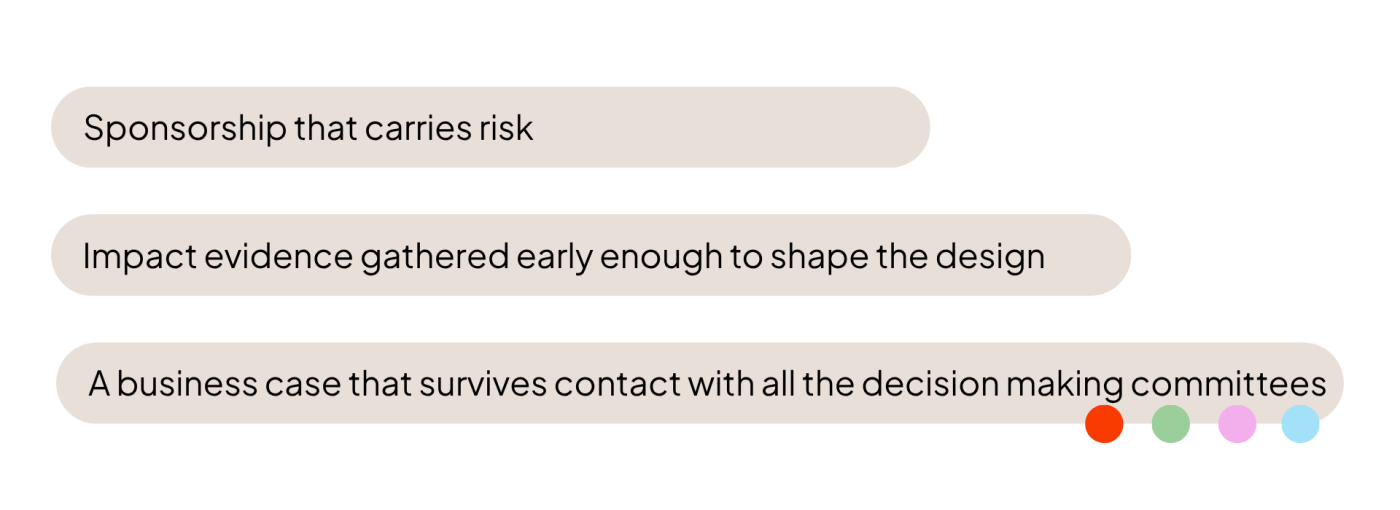
In our experience, it comes down to three things:
Sponsorship is a diary commitment, not a name on a slide
Boards are rarely short of enthusiasm for digital. What they are short of is a defensible way to carry the risk. So they do the reasonable thing and offer support instead of sponsorship, which are very different products. Support is a warm word of confidential alliance. Sponsorship is a named person taking decisions in public with their name attached.
The distinction shows up in governance. Audit Scotland’s digital hub highlights North Lanarkshire, where a dedicated committee with a digital transformation remit gives elected members a structured route into scrutinising the programme, alongside a delivery board holding strategic control. That is not decoration. That is a standing forum where somebody has to make a call.
The practical fix is to stop giving sponsors demos and start giving them decisions. Three or four real ones over the life of a programme: what we are stopping in order to do this, what risk we are consciously accepting, what we will do if the benefits don’t land, and who owns the service once the programme closes. A sponsor who has answered those questions on the record will defend the investment when it gets difficult. A sponsor who has only seen the prototype will not, and it is unfair to expect them to.
There is a national version of the same gap. Audit Scotland’s Tackling digital exclusion work found it unclear who is responsible for delivering Scotland’s national digital strategy across Scottish Government, local government and the third sector.
Ambiguous ownership at the top makes ambiguous ownership further down look normal, and ambiguity creates a lack of clarity.

Impact assessments are design inputs, not paperwork
DPIAs, EQIAs, island communities impact assessments, children’s rights and wellbeing assessments. Done at week eleven of a twelve week project, they are a compliance tax and occasionally a nasty surprise. Done in discovery, they are the single best source of evidence about where your service might quietly exclude people.
That matters commercially as well as morally. Digital exclusion is not an edge case in Scotland, and a board being asked to approve national rollout will reasonably want to know who the service leaves behind before it signs. If you can answer that question with evidence gathered in week two rather than assurances offered in week eleven, you have removed the most common reason a good proposal gets deferred.
In discovery work we led recently with a national health body in Scotland, designing equity and accessibility from the outset was not a governance overhead. It was the thing that let the programme show a Technical Design Authority a credible route to national coverage, rather than a service that would work well in the central belt and patchily everywhere else.
The business case fails on the number, not on the idea
Almost nobody disputes that the thing is a good idea. What gets challenged is the benefit.
Digital business cases habitually claim cashable savings that finance directors have watched evaporate before, then lump released staff capacity in alongside them as though the two are the same currency. They are not. Cashable savings come off a budget line. Released capacity is absorbed by the next queue unless somebody makes a deliberate decision about what that capacity is now for. Presenting them together is the fastest way to lose credibility with the one person whose confidence you most need.
Auditors have noticed. In its 2024/25 Best Value thematic work, Audit Scotland found Dundee City Council lacked a robust approach to defining and measuring benefits realisation, making it hard to judge whether the transformation programme had succeeded, and the council has since confirmed that benefits tracking and the financial savings associated with transformation are among the recommendations it is now working through. There are better patterns available too: Perth and Kinross developed a benefits realisation framework that captures financial and non-financial benefits from digital projects separately, which is exactly the discipline that makes a board paper believable.
Two habits are worth adopting. Build the case with finance rather than presenting it to them, so the assumptions are theirs as much as yours. And write a genuine do-nothing option, because the cost of the status quo, rising demand against a shrinking real-terms budget, is usually the strongest argument in the document and usually the paragraph nobody bothered with.

Reuse is where the money is, and nobody funds the boring bit
The Digital Strategy for Scotland and its Sustainable Digital Public Services Delivery Plan 2025-2028 put common platforms and shared components at the centre of the ambition, with ScotAccount and ScotPayments as the visible proof points. The logic is sound: reduce duplication, reduce cost, move faster.
But reuse only works if the second adopter can pick the thing up, which means documentation, a support route and a team that maintains it. That team belongs to nobody and is funded by nobody. Until that is resolved, scale will keep meaning, each body rebuilding a version of the same service in slightly different colours, which is the most expensive way to be innovative that anyone has yet invented.
A provocation, not a verdict
None of this is an argument against pilots. Pilots are how you find out cheaply whether something is worth doing, and Scotland does them well. The argument is that we should stop treating the gap between pilot and service as a technical or procurement failure, and start treating it as what it is: a question about money and ownership that we have been leaving until after the interesting part is finished.
Budgets are stretched and workloads are piling up. That is precisely why the discipline matters. In a generous funding environment you can scale things on enthusiasm. In this one, you scale what you can evidence, sponsor and pay for. Everything else stays on the shelf, however good it was.
Authors

Related

Article • 29 September 2026
The most valuable use of AI in financial services is far from the customer experience.

Article • 21 September 2026
AI bias is in your models more than you realise

Article • 15 September 2026
How mental health apps can support the unsupported and where AI might fit in – if at all.

Article • 04 September 2026
The Inov8 Consulting brand officially becomes Waracle
