
Recently, I decided to push past this passive setup. I wanted to see what happens when you transition into a true, agentic development workflow.
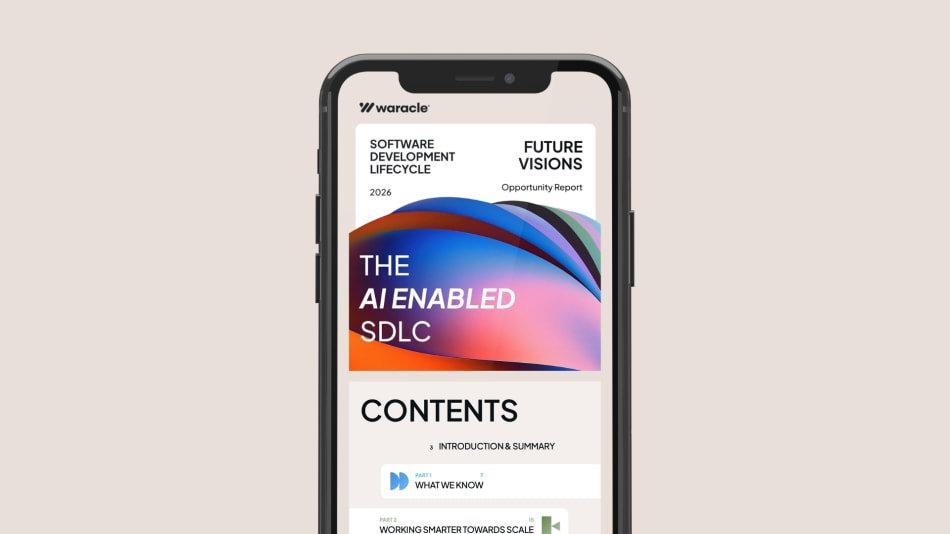
My catalyst was Waracle’s 2026 AI-Enabled SDLC Whitepaper. Looking through the data, one specific statistic stood out: a claim of up to a 60% efficiency gain in isolated, well-scoped individual tasks.
To be frank, my initial reaction was scepticism. It sounded like typical marketing hype.
But as a practitioner, I wanted to test the absolute limits of the tool in the trenches. I wanted to live that 60% scenario, experience what it actually feels like inside a codebase, and find the honest catch.
I discovered that the individual velocity gains are real. In isolated sprints, tasks that used to require weeks of compounding, mechanical effort can indeed be orchestrated in a matter of days. But experiencing this productivity “ceiling” firsthand revealed a much deeper, more important truth about the current state of software development.
Individual speed vs. systemic velocity
Before diving into the mechanics, we have to establish an honest boundary.
There is a massive difference between accelerating an isolated, well-scoped task and accelerating an entire project lifecycle. During our early research trials at Waracle, we watched individual developers achieve staggering 8x speed gains in isolated coding tasks. Yet, when we looked at the macro level, overall project timelines only improved by 10% to 20% at best.
Why the discrepancy? Because writing code is only a fraction of the Software Development Life Cycle (SDLC).
The 60% efficiency gain highlighted in the report is a theoretical ceiling for an isolated developer in a clean sandbox. It is not an automatic benchmark for an entire enterprise project. When we pretend individual coding speed equals organisational velocity, we mistake a vanity metric for actual business value.
But if we accept this boundary, understanding how to reach that individual ceiling is still an incredibly powerful tool for any engineer. Here is how that shift occurs.
Prompting as architectural precision
The ultimate misconception about agentic workflows is that the AI does the thinking for you. In reality, your output is completely bottlenecked by your ability to articulate intent. Instead of thinking about “typing code,” your mindset must shift towards defining constraints.

When you treat AI as an autonomous partner capable of executing across multiple files, your role shifts from a tactical coder to a systems architect. You are forced to cultivate extreme clarity. You must scope the problem space precisely, isolate dependencies, and provide pristine context.
The agent acts as a mirror for your own engineering discipline. If you give it a muddy blueprint, it will build a muddy house.
As my prompting sharpened, the feedback loop tightened. Instead of spending hours debugging syntax errors or chasing hallucinations, I spent minutes refining the foundational logic. This loop removes friction from the hardest parts of development because it rewards clear, systemic thinking over brute-force typing.
Redefining time to value
As noted in the 2026 AI-Enabled SDLC Whitepaper, we have to move past legacy developer metrics:
“Lines of code per hour is a vanity metric. The figure that matters is time to value.”

Measuring a developer by output volume is a relic of an old paradigm. The real shift happens when the tool moves past simple tab-completion and gains context of your entire codebase.
- Autocomplete predicts the next word.
- An Agent executes the next goal.
When an agent can parse your local repository, comprehend your existing architecture, and understand how your modules interact, the productivity story changes. Rather than generating isolated snippets, you are directing an agent to build out complete, multi-step features that actually fit into your ecosystem. By offloading that mechanical implementation, you drastically shorten the distance between a product roadmap and real-world user value.
What is the real bottleneck in enterprise projects?
This brings us to the honest catch.
If an individual developer can achieve this kind of cognitive leverage in a sandbox, why are enterprise projects still taking months to get out the door?
The answer is: local acceleration hits an organisational wall. You can write code 60% faster, but if your deployment pipeline takes two weeks, if your security audits are manual, if your architecture is buried in decades of undocumented legacy debt, and if your regulatory compliance checks are bottlenecked by silos, your individual “developer superpower” is neutralised.
The real engineering challenge of our time is not making the developer type faster. It is figuring out how to scale this cognitive leverage across an entire organisation.
If this is what a well-scoped, individual workflow looks like, what would it take to get anywhere close to that level of efficiency in a legacy, highly regulated environment?
Solving that systemic problem is where the real value lies. It requires looking at the entire SDLC – from governance and automated compliance to architecture and platform engineering – and designing an environment where human expertise and agentic execution can move together without friction.
That is the journey we are navigating with our clients at Waracle. The individual tools are ready. The question is: is your enterprise operating system ready to support them?
Want to read the full research, data, and methodology behind AI’s impact on the software development lifecycle? Download Waracle’s 2026 AI-Enabled SDLC Whitepaper.
Authors

Related

Article • 29 September 2026
The most valuable use of AI in financial services is far from the customer experience.

Article • 21 September 2026
AI bias is in your models more than you realise

Article • 15 September 2026
How mental health apps can support the unsupported and where AI might fit in – if at all.

Article • 04 September 2026
The Inov8 Consulting brand officially becomes Waracle
