There’s an uncomfortable truth in wealth and asset management that nobody talks about at conferences, but everyone knows in the corridors: most people don’t engage with their pension until it’s too late to do much about it.
The reasons are well-documented and entirely human. Pensions are abstract, retirement is distant, the language is impenetrable, and the annual statement that lands on the doormat – or more likely, in the email spam folder – does precisely nothing to make someone in their thirties feel like this matters to them right now.
The industry knows this. It spends significant sums trying to fix it through better portals, cleaner dashboards, and simplified fund information. All worthwhile. But fundamentally, pension providers are still asking people to care about spreadsheets. And people don’t care about spreadsheets.
So when Aegon came to us with a challenge around pension engagement, we wanted to try something different. Not another portal refresh or explainer video. Something that would make someone stop scrolling, laugh, and – almost by accident – think about their financial future for the first time in years.
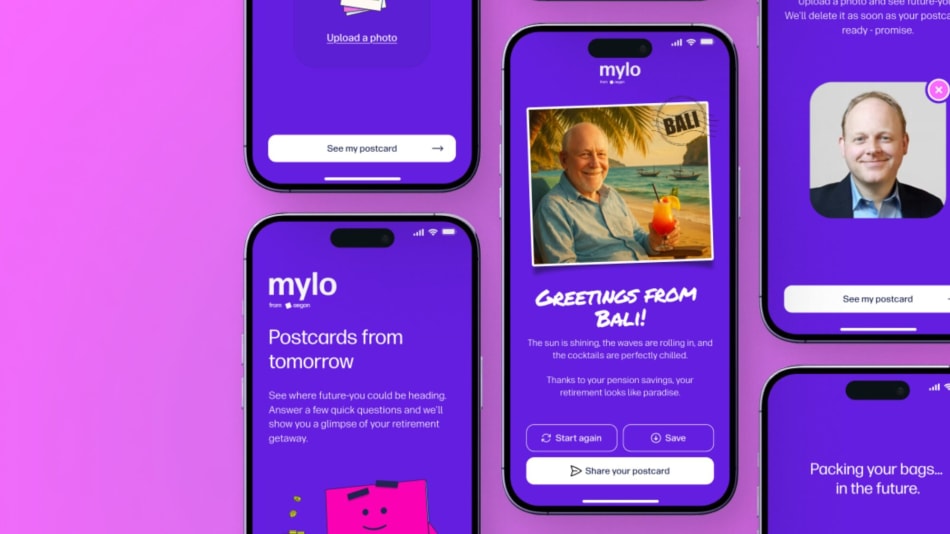
The result was “Postcards from tomorrow.”
Making the abstract personal
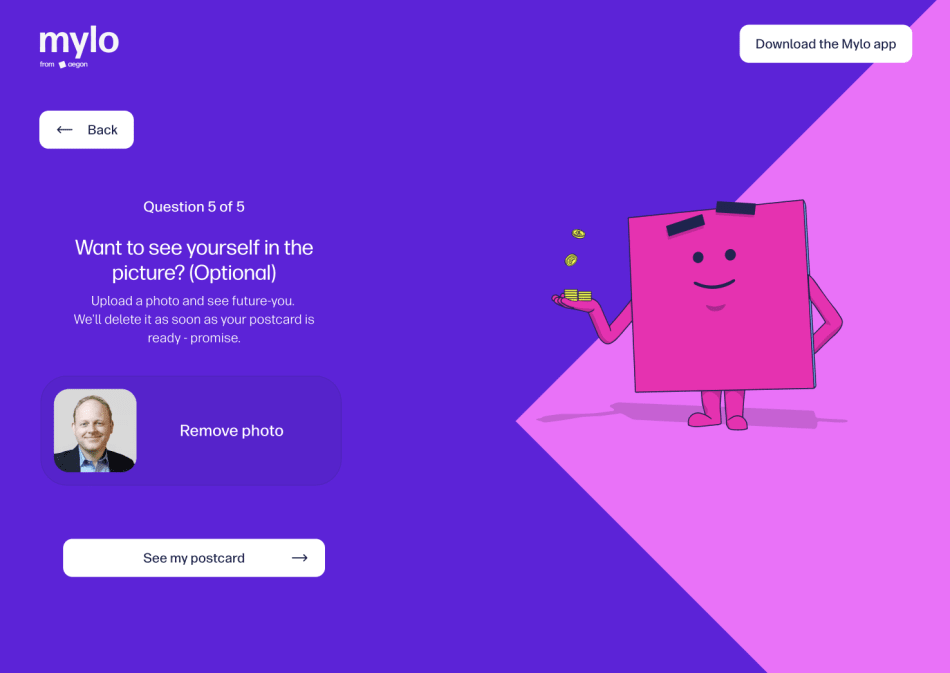
The concept is deceptively simple. A user visits a campaign site, answers a handful of high-level questions about their pension, uploads a photo of themselves, and receives a personalised, AI-generated image of their future self – living the retirement their current pension might (or might not) afford them.
It’s playful. It’s shareable. And buried inside the humour is a very useful and practical nudge: here’s what your choices today could mean for you tomorrow. The emotional response, whether that’s a grin or a slight wince, does more work than any table of projected annuity rates ever could.
But the interesting story isn’t just what we built. It’s how we built it – and how the Google Cloud ecosystem made it possible at a pace and cost that would have been unthinkable even a year ago.
A Google-native build, end-to-end
We prototyped the application in Firebase Studio, Google’s rapid development environment that sits within the broader Google Cloud platform. For those unfamiliar, Firebase handles authentication, hosting, database, and deployment in a single integrated stack – and crucially, it connects natively to Google’s AI services. For a campaign tool that needs to be live, robust, and scalable without a lengthy backend build, it dramatically collapses the distance between idea and working product.
But the heart of the experience was always going to be the image generation, and that’s where staying within the Google ecosystem really paid off.
We needed a model that could take a user’s photo and produce something high-quality enough to feel worth sharing, varied enough that people wouldn’t all get the same beach scene, and fast enough that nobody would lose patience and close the tab. After evaluating the options, Google’s Nano Banana – the image generation capability within the Gemini model family – was the only publicly available model that delivered on all three.
The quality of the outputs, the instruction-following capability, and critically, the ability to maintain likeness whilst placing someone in an entirely new context, made it viable for a real consumer-facing product rather than just an internal demo. And because Nano Banana is accessible through the same Google Cloud infrastructure that Firebase already connects to, the integration was seamless. No bridging between disparate cloud providers, no awkward API translation layers, no separate billing relationships to manage. One platform, one set of credentials, one coherent stack from front end to AI pipeline.
That architectural simplicity matters more than it might seem. In regulated financial services, every additional integration point is a compliance conversation, a security review, and a potential point of failure. Keeping the entire stack within Google Cloud meant we could move fast without creating the kind of sprawling infrastructure that makes compliance teams nervous.

The bigger principle: AI as both the product and the means of production
Here’s where it gets interesting for anyone in wealth management thinking about their digital strategy.
Postcards from tomorrow is an AI-powered engagement tool. That’s the obvious bit. But it was also an AI-assisted build. The development team used AI tooling throughout – from code generation to prompt engineering to rapid iteration on the image pipeline. The combination of Firebase Studio’s integrated environment and AI-accelerated development meant we went from concept to live product in a fraction of the time a traditional build would have taken.
This creates a compounding effect that changes the economics of engagement. When the cost and time to create these experiences drop dramatically, you can afford to experiment. You can build campaign tools that would previously have been dismissed as too expensive for a short-lived activation. You can test ideas with real users rather than debating them in committee for six months.
And this applies far beyond pension engagement. Consider the possibilities across wealth and asset management: personalised portfolio visualisations that show clients the real-world impact of their investment choices. Onboarding experiences that use generative AI to explain complex products in plain language, tailored to each individual’s level of sophistication. Intergenerational planning tools that help families visualise wealth transfer scenarios together rather than through separate, sterile documents.
Google’s investment in making these AI capabilities available through a consistent, enterprise-grade cloud platform is what turns these from interesting thought experiments into deliverable products. The models exist. The infrastructure to serve them at scale exists. The barrier is now imagination and the willingness to try.
Taking the risk out of innovation
There’s one more piece to this story that matters for any wealth manager considering this kind of work. Waracle hosted and operated Postcards from tomorrow as a managed service on Google Cloud. We didn’t hand Aegon a codebase and wish them luck. We ran it.
This isn’t a minor detail. In regulated financial services, the question of who operates a consumer-facing AI tool – who monitors it, maintains it, and takes responsibility when something needs fixing at 10 pm on a Thursday – is often the thing that kills innovation before it starts. Internal technology teams are already stretched. Compliance teams are understandably cautious about anything new. And the last thing anyone needs is an engagement campaign that generates a PR problem because nobody was watching.
By taking on the hosting and operational responsibility, we removed one of the biggest friction points in getting these ideas from concept to market. The client gets the engagement benefit without the operational overhead or risk of managing an AI-powered service in-house. We get to apply the operational expertise and monitoring that comes from running these things day in, day out – on infrastructure we already know inside out.
It’s a model we’re now applying to similar engagement challenges across the sector. The specifics vary – not everyone needs AI-generated postcards – but the principle is consistent: reduce the risk for the buyer, and innovation becomes a much easier conversation.
What comes next
The technology continues to move. Since we built the original Postcards experience, Google has shipped Nano Banana 2 – the next generation of the Gemini image model – with improved fidelity, faster generation, and significantly better creative control. Nano Banana Pro has been followed for use cases demanding studio-quality output. Each iteration widens the gap between what’s possible and what most organisations have attempted. Even Firebase Studio has moved on with tools like AI Studio and Stitch coming of age since then.
For wealth managers still weighing up where generative AI fits in their strategy, the message from this project is straightforward. The hardest part wasn’t the technology. It wasn’t the compliance. It wasn’t even the AI. It was convincing someone that a playful, AI-generated postcard could do more for pension engagement than another well-meaning PDF. That making people smile might be a more effective financial planning intervention than making them read.
Turns out, it can.
If you’re thinking about how generative AI could drive engagement in your wealth or asset management business – whether that’s client acquisition, retention, intergenerational planning, or adviser enablement – we’d love to have the conversation. The tools are ready and the platform is proven. The only question is what you want to build.
Authors

Related

Article • 29 September 2026
The most valuable use of AI in financial services is far from the customer experience.

Article • 21 September 2026
AI bias is in your models more than you realise

Article • 15 September 2026
How mental health apps can support the unsupported and where AI might fit in – if at all.

Article • 04 September 2026
The Inov8 Consulting brand officially becomes Waracle
